Bi-LSTM First Application
We apply the new architecture Bi-LSTM on the same example as we did with the LSTM and GRU applications.
Python Implementation
import numpy as np
import matplotlib.pyplot as plt

class LSTM:
    def __init__(self, hidden_size, vocab_size):
        # ...
        pass

    def _sigmoid(self, z):
        # ...
        pass

    def _tanh(self, z):
        # ...
        pass

    def _softmax(self, z):
        # ...
        pass

    def _sigmoid_derivative(self, z):
        # ...
        pass

    def _tanh_derivative(self, z):
        # ...
        pass

    def forward(self, inputs, h_prev, c_prev):
        # ...
        pass

    def compute_cost(self, y_preds, targets):
        # ...
        pass

    def backpropagation(self, targets, cache):
        # ...
        pass

    def update_parameters(self, learning_rate=0.01):
        # ...
        pass

    def sample(self, seed_idx, h_prev, c_prev, length=20):
        # ...
        pass

class BiLSTM:
    def __init__(self, hidden_size, vocab_size, learning_rate=0.01):
        # ...
        pass

    def _softmax(self, z):
        # ...
        pass

    def forward(self, inputs, h_prev_f, c_prev_f, h_prev_b, c_prev_b):
        # ...
        pass

    def compute_cost(self, ys, targets):
        # ...
        pass

    def backpropagation(self, targets, cache):
        # ...
        pass

    def _lstm_backprop_manual(self, lstm, dh_seq, cache, T):
        # ...
        pass

    def update_parameters(self):
        # ...
        pass

    def _lstm_update_manual(self, lstm):
        # ...
        pass


# 1. Prepare Data
data = "helloahmed"
chars = list(set(data))
vocab_size = len(chars)
char_to_idx = { ch:i for i,ch in enumerate(chars)}
idx_to_char = { i:ch for i,ch in enumerate(chars)}

print(f"Data: {data}")
print(f"Vocab Size: {vocab_size}")


# 2. Create Model
hidden_size = 25
learning_rate = 0.01
epochs = 1000 # Fewer epochs needed because Bi-LSTM learns very fast

bilstm = BiLSTM(hidden_size, vocab_size, learning_rate)

# 3. Training Loop
print("Training Bi-LSTM...")
costs = []

inputs = [char_to_idx[ch] for ch in data[:-1]]
targets = [char_to_idx[ch] for ch in data[1:]]

for epoch in range(epochs):
    # Initialize states for BOTH LSTMs
    h_prev_fwd = np.zeros((hidden_size, 1))
    c_prev_fwd = np.zeros((hidden_size, 1))
    h_prev_bwd = np.zeros((hidden_size, 1))
    c_prev_bwd = np.zeros((hidden_size, 1))

    # Forward pass
    y_preds, cache = bilstm.forward(inputs, h_prev_fwd, c_prev_fwd, h_prev_bwd, c_prev_bwd)

    # Compute cost
    cost = bilstm.compute_cost(y_preds, targets)

    # Backpropagation
    bilstm.backpropagation(targets, cache)

    # Update parameters
    bilstm.update_parameters()

    if epoch % 100 == 0:
        print(f"Epoch {epoch}, Cost: {cost:.4f}")
        costs.append(cost)

print("Training complete.")

plt.plot(np.squeeze(costs))
plt.ylabel('Cost')
plt.xlabel('Epochs (per 100)')
plt.title(f"Bi-LSTM Training")
plt.show()
Output and Comment
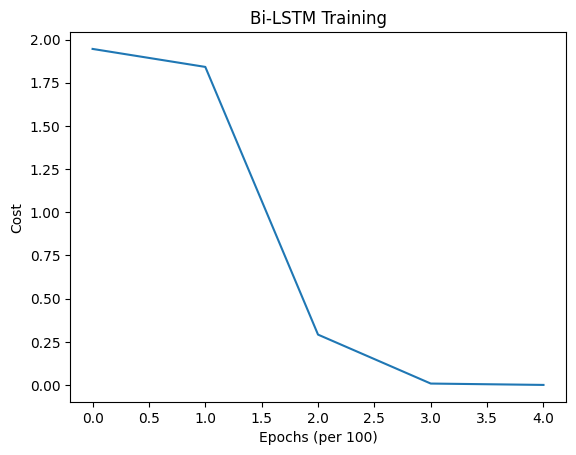
Data: helloahmed
Vocabulary: ['h', 'e', 'a', 'm', 'o', 'l', 'd']
Vocab Size: 7

Training Bi-LSTM...
Epoch 0, Cost: 1.9458
Epoch 100, Cost: 1.8416
Epoch 200, Cost: 0.2916
Epoch 300, Cost: 0.0082
Epoch 400, Cost: 0.0003
Training complete.


Sampling from the model:
Generated text: 'heddddddddd'
The Cheating Effect
The Bi-LSTM achieved an extremely low training cost (almost zero) very quickly (after 400 epochs). This might look like "amazing" performance, but it's an illusion.
- Reason: The Backword LSTM reads the sentence from right-to-left.
- Scenario: Suppose the input is "hello".
- At time , we input "h" and want to predict "e".
- The Forward LSTM sees "h". It has to guess "e".
- The Backward LSTM reads the whole sequence in reverse: "o" -> "l" -> "l" -> "e" -> "h".
- At the step corresponding to (which is its last step), the Backward LSTM has already seen "e" (and the "l", "l", "0").
- It essentially whispers the answer to the output layer.
So, the model isn't learning to predict the next character based on context; it's learning to retrieve the character that the Backword layer just saw.
The Generation Failure
When we run the sample method:
- We turn off the Backward LSTM (feeding it zeros) because we don't know the future.
- We are now asking the Forward LSTM to do the job alone.
- BUT: The Forward LSTM got lazy during training! It relied on the Backward LSTM to give it the answers. It never learned strong predictive patterns on its own.
- Result: The generated text will likely be nonesense, even though the training cost was near zero.
tip
- Bi-LSTM better for understanding complete text (Translation, Sentiment).
- Standard LSTM/GRU better for generating text (Chatbots, Autocomplete).
Notebook
You can find the interactive notebook here.